Total Pageviews

Wednesday, 9 February 2022

Black Cat Pictures from Baycliff, Cumbria, 2994

 Wednesday, 21 July, 2004 16:08

From:
"Jennie Dennett" <Jennie.Dennett@kendal.newsquest.co.uk
To:
earegister2003
"pix coming shortly! I've had to get our photographers to re-save them as the file sizes were too big for e-mail."

"Hi Terry
These are the pix taken by quarryman Mike Hodgson at Baycliff. They were taken in April but the guy has only just come forward with them. They're on film (we've got the negatives) and taken with a little instamatic.

"As you'll see the cat is quite far away but the ears are quite clear. I measured the rock the cat's sitting next to in pic 2 and it was 50cm high.

Look forward to hearing your expert view."
Jennie
01229-588989 (or Fridays 01539-710175)
Terry Hooper wrote:
"Dear Jennie,
I thought I'd best put this in writing so everything is made clear.
I have taken photo A [tree to left,cat in mid view in front of rocks]and enlarged and printed it to A4.
First point;is it the print or is there a fence beyond the rocks? It probably is my print but if there was a search for fur might be in order. moot pointprobably! If the rocks are the size you say then this is a largist cat -my tallest seated only comes to about 40cms. Are we sure the cat was just seated and not,erhum,"manuring" the area?
Photo B isn't that brilliant,though. 
Photo A, as I say, is the best. Obviously melanistic [black]. Any idea how tall the grass was at this spot as that would help size assessment? Ears seem to be wide set and low;I checked with head shots of [1]puma and [2] panther/leopard. The powerful shoulders of the leopard cannot be seen due to angle. The head-set is interesting, ditto shape. If -IF- this is not a hoax then I'd have to say it looked like a black leopard but as you'll understand there are a lot of "ifs" and "buts".
If the photographer can get snap shots of any future dead lambs in situ,in close up [showing wound] and roughly draw lamb shape and show where wounds are it would be helpful. My comment would be,officially: "This could very well be a photograph of a black leopard based on the information given.
It is a VERY tantalising set of photos." Unofficially,"Why can't these cats have lighter coats!" Definitely like to keep up-dated on this. If I can get a copy of the article eventually,great! Postal address [PLEASE don't give my phone number out as I'm inundated with writing this paper*] can be given. I'll let you know if I get any feedback -ANYTHING sounds really good you CAN pass on my number! (*the paper is titled:THE RED PAPER:THE EVIDENCE FOR THE EXISTENCE OF LARGE NON-NATIVE CATS IN THE UNITED KINGDOM 2004. (Due for release circa OCTOBER, 2004 )
Thanks for the photos!"
Terry

Jenny Dennett:
Hi Terry
Here's the Gazette report.

This is the full version on the website - a shorter piece went in the paper on p1.
Best of luck with the paper, I look forward to reading it.
Any chance of an exclusive?!

Jennie
Article
IS THIS picture the long-awaited proof that big black cats are on the prowl in Cumbria?
Mike Hodgson took this snap at his Baycliff quarry near Ulverston when he suddenly encountered what he described as a spaniel-sized jet black cat walking through the grass 55 metres/60 yards away.
After numerous reported sightings of the non-native predators across Cumbria, Mr Hodgson is the first person to come forward with any photographic evidence.
“I was just locking up the quarry at about 5pm and I saw this thing looking at me,” he said. “So I got out the camera I have with me for taking pictures of stone and took it.
“It was bigger than a domestic cat… really quite a good looking cat with a long tail, well fed and looked happy. It wasn’t frightened of me.”
The 55-year-old quarryman then stowed away his snapshots which were taken in April for fear of ridicule. He only retrieved them this week after another, more lingering encounter, with the black cat last Thursday when it stayed in sight for a full five minutes.
Mr Hodgson is sure what he has on film is no domestic pussy.
“I know what I saw. If it was a normal cat I wouldn’t have bothered getting my camera out.”
The Westmorland Gazette’s photographic team was happy Mr Hodgson’s negatives were bonafide. But the question of whether the black shape in the picture is really a ‘big’ cat is harder to answer.
In the three pictures captured by Mr Hodgson, one features the feline sitting in front of a big rock 21m/23yds away from his lens. The rock - which reaches the cats’ head - is 50cm/20” tall but since it is impossible to tell exactly how far it is from the rock the measurement can only serve as a rough guide.
Bristol-based black cat specialist Terry Hooper, who compiles the official exotic animals register, said a big domestic cat in sitting position would be around 40cm tall. A male black leopard would measure around 50cm and beyond.
Mr Hooper also compared the photos to head shots of pumas and black leopards (which are different types of the same species as black panthers).
He concluded: "This could very well be a photograph of a black leopard based on the
information given. It is a very tantalising set of photos."
However Mr Hooper added that there were too many ifs and buts for the shots to offer conclusive proof.
The pictures have sparked fresh questions over the death of seven lambs near Baycliff at Sunbreak Farm, Bardsea in April. Each was found with teeth marks on its neck.
However farmer Richard Parker was still sure dogs were behind the attack while Mr Hooper said there was not enough evidence to determine if it could have been a black cat.
In the last four years, The Gazette has reported more than thirty sightings of the elusive creatures across South Lakeland, Furness and North Lancashire, with particular hot spots just south of Kendal and along the M6 between Shap and Kendal. Recently in Furness one was seen strolling across Walney Bridgeat night. Back in 1995 at Grizedale Forest two police officers parked-up for a mug of coffee even saw two juvenile big black cats at the same time.
The best proof of their existence so far comes from Gatebeck near Endmoor in October 2000 when a dentist took plaster casts of two massive paw prints found in her garden.
“Cumbriais the perfect environment for these cats,” said Mr Hooper. “They have deer and rabbits…I think there are five of them in and around Cumbria.”
Certainly in Baycliff plenty of support could be found for Mr Hodgson’s confidence that he had captured on camera at least one of the creatures in their midst.
“I looks bigger than a normal cat,” concluded Helen Barlow of the Baycliff Farm Shop. “I have certainly never seen any exceptionally large domestic cats round here that it could be.”
Meanwhile her entrepreneurial husband Martin was already thinking ahead to the marketing opportunities offered by a ‘Beast of Baycliff’.
“These are big cat steaks,” he quipped proffering a tray of juicy rump steaks.
2022: I have a much better computer and editing stuff now to state that enlarged this looks like a black domestic feral? Could well be one of the "Hooper Cats" based on size but NOT leopard or puma

Note: as almost two decades have elapsed this report is deemed publishable


Sunday, 6 February 2022

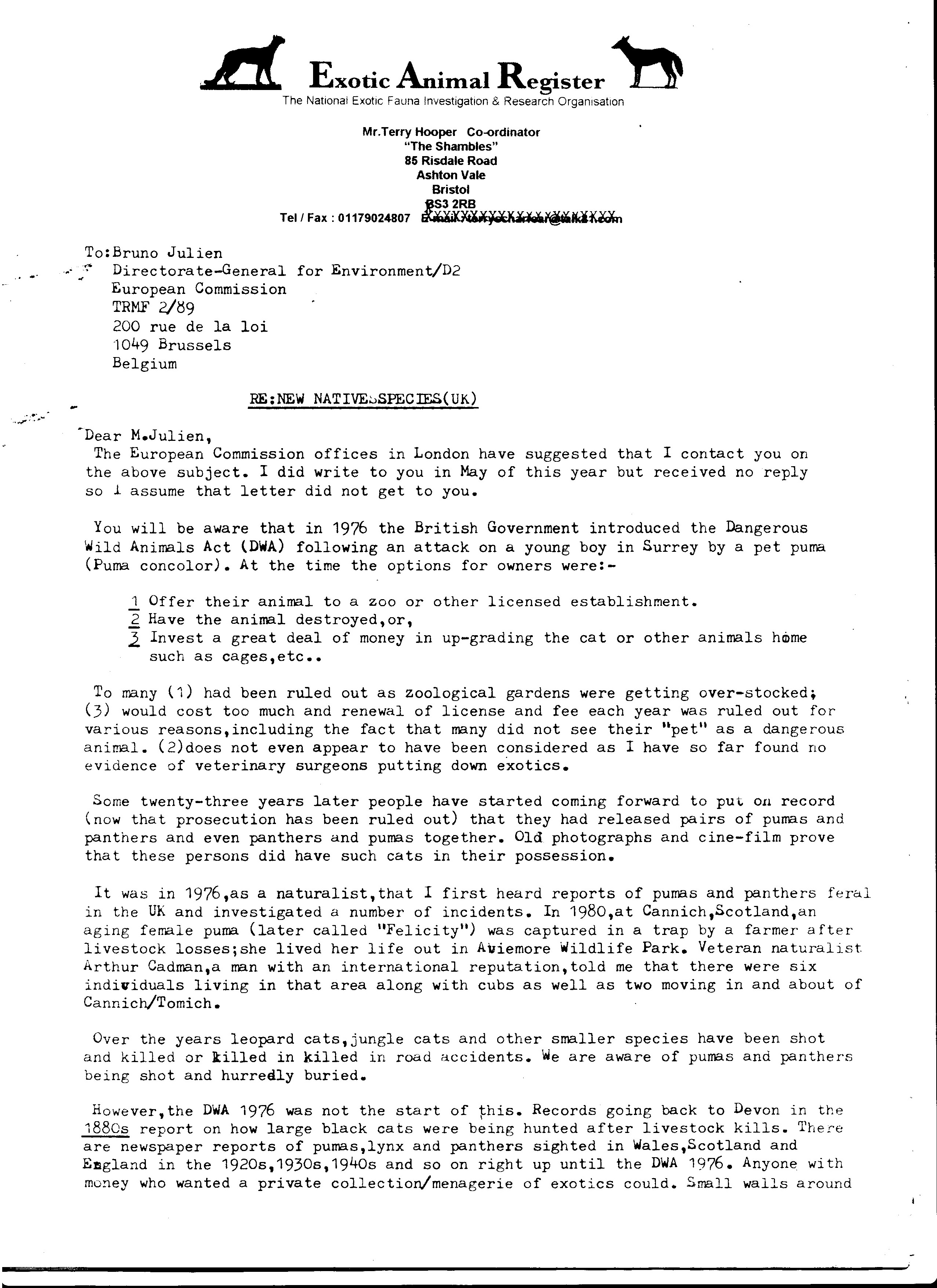
2000 Correspondence With European Union of New ("exotic") Faun In The UK

 NB: these letters can be found on the EAR Face Book page also


Back in 1999/2000 my work on The Red Paper: Felids was complete. I had all the information and evidence I needed based on standard naturali history and wildlife research criteria.

However, I knew that if I released the full report it could be used by illegal hunting groups and even the Department for Environment Farming and Rural Affairs (DEFRA) for its "eradication" (killing) programme and I even had written affidavit from people who had witnessed this first hand.

I think the letter says it all (we were still using typewriters back then!). Unless there was full acceptance that these animals were out there and that despite (in some cases) a couple hundred years living in the UK countryside there had been no attacks on humans and it could be proven based on testimony that these animals had a positive rather than detrimental effect on the countryside then I was not going to publish.

And A-Z guide on where to find and kill was not going out there, And so I contacted the EU (which was aware of my work) and tried to ascertain how things were and whether they could be changed.

22 years on we know the situation has not change. I think the EU letters from 2000 shows that there was no real interest in openly accepting that exotics had become native and it was far easier to just kill anything that "didn't fit" in with some bureaucratic national view -some "native fauna" in the EU as well as UK are "native" only for convenience as they, like todays "new fauna", were set free or escaped because of human activities.

Interestingly it was during this period that I was referred to by an EU official as an "environmental conservationist" (and we were not using the term "Citizen Scientist" back then).

Here is my letter plus the EU response that shaped my decision.


The EU Responses


Wednesday, 2 February 2022

EAR FB


 https://www.facebook.com/groups/372804871017547

The "UK Government and Police Are Covering Up on Big Cats"


This is something I hear again and again from so called "big cat experts". It may just be that wearing black or combat uniforms in their living rooms has scrambled their brains and they are fantasising. No idea. I really believe some of them just make this stuff up as it makes them sound like "fighters for the truth" rather than idiots.

There is one thing that I shared with my (no longer with us) contemporaries who were all field naturalists and didn't just hold a two hour "big cat watch" -cooperation from police forces. The police needed answers or guidance so it made sense that they went to naturalists as most zoologists were too scared of being quoted or drawn in to the subject (and spent very little time in the field).

I once went to see the DEFRA (Dept of Environment Farming and Rural Affairs) exotics spokesmena when it was still MAFF and he was based in Bristol. I went up to reception and told the person I was there to meet ----- and my folder was stared at for a few seconds and I was asked "Oh, is it about big cats?" I said it was. The person went off and came back with a rather flushed looking DEFRA man who was way too polite! I was told that we could chat in his office and when we got there I took out some plaster casts I had in my shoulder bag. "Oh!" he said looking at them "they do look like the ones we have"

He then opened a cabinet drawer -one of the big map cabinets. There, labelled "lynx", "Puma" and "p. pardus" (leopard) were about twenty plaster casts and they lookd like they had all been professionally checked out. So I took mine over to the cabinet and we were comparing when I said "I knew MAFF had tracks but a few more than I expected". Heturned to me and looked shocked and red faced: "You're from London?" I told him I was not and explained we had spoken over the phone. I was then very quickly ushered out with a "please direct all enquiries in writing" and that was it.

Turns out he had been told by the desk person that I was from London -having seen one of the documents sticking out of the folder.

Up until that point I had not really believed that MAFF/DEFRA had good quality plaster casts of exotic cat prints. 

Years later another secretary put me through to the Welsh Chief Veterinary officer and we were discussing livestock kills when I was asked "Who are you again?" As soon as I identified myself I was told very rudely that I had no business contacting her and the phone was put down. After that incident some farmers were told -told- that any animal suspeced of being killed by a cat should be reported to them first and not be reported to me. 

Very long story but one day an irate farmer contacted me to ask what was going on with the sheep -was it killed by the cat or not? I had no idea what he was talking about. He explained that one of his sheep had been killed and that it had looked like "one of the cats again" and mentioned it to his vet. Within an hour a white van pulled up and the farmer met a man claiming to work for me and I had, apparently, told him to pick up the sheep to post mortem and we would let him know results within a week. Well, I worked with only two other people (not in Wales) and we had no white vans let alone the ability to PM a dead animal. So who was it?

The week afterthe farmers phone call another phoned. Based in Wales and he had helped me with livestock losses before. He was also a very respected man who worked with MAFF/DEFRA to explain policies to farmers in the region. He was a drinking pal with one of the officials and over a drink he mentioned another sheep that had been killed and partially eaten. His companion said in a hushed tone: "That hasnt been reported on has it? We dont want that ***** in Bristol to get his hands on the evidence". He was asked to explain and was told that "Terry Hooper is a ***** pain" (I felt so proud!). After the chat the farmer went back to his place to get the form I had provided him and to get a camera to go see the farmer who had found the new kill.

He told me: "It took about an hour or just over as there had been a road slip on the way over. Also some bloody fool in a van almost hit my Landrover.  I got there and explained to the farmer I needed to get details and photos of the dead sheep. Well, he just stared at me and said 'Terry Hooper? He was just here and took the sheep off in his van -you just missed him!' -that's why I called you and you've made a six hour journey home to Bristol in two hours!"

Obviously I was not driving a van with a dead sheep in. 'I' was described as sandy haired (no) and about 6 feet tall (no) and clean shaven (no). Apparently this mysterious person had turned up in a rush and explained he needed the sheep and put it into the back of the van -"had an inbuilt cage like some vets use".

This was all very silly really. I was a naturalist and could have helped if only as an advisor as I did with UK police forces. Everyone from naturalists, some zoologists, farmers unions and police forces knew the various cats were here. Thanks to a back-stabber on the team we were prevented -by DEFRA- from fitting a radio tracking collar on a puma in Wales and taking samples for testing because if we trapped the cat "the law is quite clear; you either humanely destroy (kill) the cat or take it to a zoo or other animal facility".

I even have the signed affidavits of veterinarians having "put down" trapped cats.

This is common practice with any exotic -considered an invasive species- and killing raccoon like dogs, etc has even been reported in newspapers "because they are considered an invasive species".

DEFRA obviously prefers not to publicise trapping and killing as most would explain that a true survey/study needs to be undertaken as some cat species are on record as living in certain areas for over three hundred years and in fact there has been no detriment to UK wildlife -some estate owners and game keepers report deer herds for instance being stronger and free of sick or straggling members because of cats.

It is not a cover up just bureaucrats following every rule without question because they do not want a fuss or to attract a lot of protest. They are not a National Carnivore or wildlife advisory. They are "keyboard tappers".

This is why absolutely nothing I have learnt since 1977 will ever see print. Hunting and killing protected species as well as other wildlife continues seemingly unabated (it is why the locations of foxes and badgers are closely protected by people). And there are the illegal hunting groups. Until the laws are changed everything stays unpublished and goes with me to the grave.

The police, however, never once (with the exception of West Midlands and Devon and Cornwall police who did not enjoy good reputations so it was expected) got in the way and their wildlife crimes officers knew what was going on and we regularly spoke. PWCOs from the Northern Constabulary (now Police Scotland), Dyfed-Powys, West Mercia, Kent and so on we exchanged and briefed each other. The EAR Bulletin went to the Home Office as well as all UK police forces.

The main concern of the police, whichever force, is to protect the public and not to create a panic. On three occasions over the  years I have seen how such panics have been caused and in all three cases the reports were hoaxes. 

Therefore when you see the current crop of 'experts' (before they jump to the next craze) talk about government and police cover ups remember that they have no experience or idea whatthey are saying. this is their hobby.

Tuesday, 25 January 2022

Do you have evidence of a large cat in the UK or cat kills?

(c)2022 Dreamstime.com


 Along with some of my contemporary fellow naturalists in the 1970s I set up guidelines on how to observe, track and record "non native" cats in the UK. By 1980 I ad established the procedure to investigate cases and gather evidence -specifically of large cat species since other species such as wallabies were known and in their case it was merely an exercise in update where and when and offering advice when required.

Foal skull bearing teeth marks identified as "large felid" (c)2022 EAR/T Hooper-Scharf

Even UK police forces for whom I acted as an advisor of large cats adopted many of the procedures. The most important one being to not draw lots of press attention that would create a panic or get the hunting groups blasting away at anything in the dark in the hopes of a "big game kill" -those people/groupos existed and were often reckless and carrying out illegal activities of which trespass was the mildest.

The EAR Bulleti had a wide distribution amongst police forces and other bodies.

Yes, we got evidence in the shape of scat, kills, DNA and even through forensic study of the bones of prey animals.  A report of a large cat if reported by phone or letter would result in a series of questions that could last an hour and would establish the credibility of the observer/report -this is why hoaxers were spotted quickly.

puma droppings (c)2022 EAR/T. Hooper-Scharf

We had plans to trap a certain cat, take samples and fit a radio collar so that it could be tracked in the countryside. However, the team involved had a sneak who informed the Ministry of Agriculture Fisheries and Food (MAFF)  -the predecessor of DEFRA- of our plans and it was made clear that if we trapped a puma we had no choice but to kill it or put it in a zoo (all of which were full at the time).

Index card entries (c) EAR/T Hooper-Scharf


Everything was logged and then marked on maps that gave an overall picture of territories, flora and fauna inthe area as well as possible habitats. All backed up by index cards because the internet was not around and when it was it was both unreliable and unsafe to store confidential reports on.  Even today no reports are put online and nothing that might identify a witness.

(c)2022 EAR/T. Hooper-Scharf


Three times I was offered fairly large amounts of money by two national newspapers for copies of my maps -and that money would have been very welcome, however, I knew (from an inside source) that the intention was to pay someone to use my maps to try to find and kill a "big cat".

From the 1980s onward British newspapers as well as radio and TV described me as "Britain's Big Cat Detective" and that, embarrassingly, stuck.

We KNOW that there is only one member of the Big Cat family in the UK and despite the word "big" it is not full German shepherd or even lion-sized. Enough info is posted on this site for those interested in facts. The other cat is a member of the medium sized cats -the puma. So people calling themselves "Big Cat experts" is silly in the extreme.

The whole reason that we KNOW there were black pumas in the UK is for two reasons; one is that a senior lecturer in zoology that had dealt with pumas encountered on under very good conditions and only about 100 yards away from him. He noted every diagnostic feature. As he put it "I knew it was a puma. If I had seen a leopard I would not have gotten out of my car to take all the road measurements to estimate size etc".  Also those long list of questions in which people reported "pumas" but gave excellent descriptions of a black leopard and these were VERY close to. Or someone who saw a "leopard" but gave a perfect description of a puma and in some cases the cats were "almost charcoal grey" or "black" and no rosette patterns were seen.

Now someone photographs a black smudge in a field a half mile away and it is classed as "a big cat".  What is clearly a dog in a photograph is called a "big cat" and there is even photographic and video evidence of "big black cats" that are in fact of black foxes. There is currently no credibility amongst the UK "big cat" community (when they are not name calling or trolling each other their lack of any knowledge on wildlife and cats in particular is explosively clear). 

"We are protecting our community -and we have the combat fatigues to prove it"

The standards and rules were set back in the 1970s and early 1980s and they have not mattered for years as getting your name in print or being on local radio or TV as a "public servant" is far more important. Looking at what has come out in just the last five years (excluding the people in Devon trying to hoax me) I think DEFRA are safe in claiming (falsely) "There is no Big Cat in the UK"

"Why do people never observe regular coloured leopards?" They do and I think I have two such reports that came from independent sources but were never published.

Leopard-tree-Kenya-Masai-Mara-National-Reserve

"Why does no one ever see any young?" They do. Of puma mainly and one pair of pumas had seperate well defined territories and we know which killed what as they both ate from different parts of the kill. Young were spotted and we know their kills as they were messy -their mother had not trained them well at all. 

We also, going back to the 1970s have a very good report -I spoke to the lady- where a puma was spotted close to the family car along with a smaller"sphinc like spotted cat". The woman HAD seen the puma at Chester Zoo but had never seen a puma cub -which is what she described in detail. Now, unless this was an "immaculate conception" you work it out!

An estate owner told me how he and his game keeper heard "the most frightful sounds" one night and decided to investigate. As they got closer to the source of the sound they peeked over a fence and there were "two huge cats -a grey one and a black one ...and they were not fighting!" Both men knew the cats were on the estate and in fact had no problem with them and I had to give a solemn promise never to tell anyone the location. The descriptions were of puma. In fact I have similar reports of 'fights' over the years.

Trying to guess or estimate a population is sheer guessology and if 10% accurate I would be shocked. "At least 50 in thecounty" and "A few thousand nationally" are nonsemnsical and whoever gives out such a statement needs to be ignored. Firstly, yes, we know some females have set territories they are comfortable in and in some they are protected. However, treks of 30-40 miles takes them in and out of counties.

There are 27 counties across the UK so let's suppose there are 10 cats in each as some claim that is 270 nationally. Now that figure of cats nationally of one species I have no problem with but spread out and not 10 per county. The pair of pumas noted earlier that we know the territory for had a wide area that took them in and out of the county and the male had a massive area he covered so I might guess -guess- a hundred nationally? The same would apply to panthers but bccause we are just guessing I would be more inclined to guess under 100 nationally. 

(c) 2022 respective copyright owner

I know , as I have the affidavits, (and DEFRA knows I know which is why they blocked any cooperation with me officially) that some cats are trapped, killed (despite there being wildlife parks and zoos that are willing to take them in -think of the money to be made with a genuine "British Big Cat" in your zoo) and then shipped off to autopsy and incinerate. There are former "exotic" cats of smaller breeds and even the "Hooper Cat" (a name coined by Police Wildlife Officers at the time) that are mistaken for pumas or panthers despite being smaller.

High zoom enlargement - pixelisation and 'spots' on the cat. In this case a dog both in shape and movement (c)2022 respective copyright owner


We also have a history of cat and other "exotic" reports and incidents going back centuries and some of these are unknown to today's "experts" as their research comes from You Tube videos and some very dubious books and online data.

There are millions of deer in the UK of various species and we know they are taken by the larger cats and in one area muntjac seemed to be the favourite. Fed up of deer? Millions of rabbits. Wild fowl -you name it and sheep are not top of the menu.

I still get the occasional police contact (not having broken a confidence in decades helps seal my credibility) so I know there are still cats roaming. 

Do you have evidence of a large cat in the UK or cat kills? A sighting? Then contact me at blacktowercg@hotmail.com or via the EAR Face Book group

Friday, 7 January 2022

Lynx CANNOT Be Reintroduced (ones already here can stay?)

  You see, if they ignore what they know (that there are lynx in the UK already and have been for decades -I even wrote a paper on the subje...