Total Pageviews

Thursday, 4 November 2021

"Brave Cops Gun Down Terror Beast Cat From Hell!" Is Never Going To Be A Genuine Headline!

 THANKS Hayley de Ronde

🙄Getting big cat flash back.

I take it these are the "Big Cat experts" (coppers out "for a jolly" it seems).

I have no problem with lynx as they have been here a very long time. We have the greyer coloured foxes now but there are other medium/small sized New cats that could be called "huge" by a member of the public.

I once stated "People report armadilloes and you find a woodlouse!". People do not know their supposedly "normal" wildlife let alone New wildlife. "It was like a wolf just staring back at me!" The animal was measured by the height of a bush -just over 12" (30cms) tall and...was a fox. "I think its an adder and I'm worried about the pets" so out I go with the extra thick gloves, covered bucket and tongs to be confronted by...a slow worm.

The problem is that this is all social clubbing -I bet those in this photo that can recite 'facts' recite the fake ones perpetuated by previous "Big Cat hunters" The fact that all (?) are police officers is is disturbing...but they get their faces in...the Star. Were they going to call in chopper back up if they saw anything or call in a fire arms unit -they seem to be fond of treating animals as "big game hunts" these days. The Star would love the headline "Brave Cops Gun Down Terror Beast Cat From Hell!"

"We want to warn and protect the public from the dangers" is the usual "local hero" bull. We have had panthers, leopards, puma and other cats in the UK for a "few centuries" now and how many attacks or deaths of people?

Zero.

None.

One woman received a scratch on her hand as she tried to take a dead rabbit (!!) from a lynx in her back garden. That is it.

Every "Big Cat Attack" story since the 1970s has been proven a hoax and worst of all the two best known involved self inflicted wounds.

WHY should I, as the UKs original (how I groaned) "Big Cat Detective" accept this as a "non native cat" sighting?

An "African lynx" -but show a photo of a caracal -which they then call a "big cat" and it is NOT.

Since the Exotic Animals Register (EAR) stopped acting as a UK Police Forces advice service it seems any silly claims are accepted and jumped on.

Rant over.

Huge 'beast' with pointed ears spotted prowling in UK village sparking police search

Derbyshire Police received a report of a dark grey beast with a giant body and pointed ears prowling near the woods in Ticknall, with witnesses claiming it resembled an African Lynx

A big cat, said to look like an African Lynx, has reportedly been spotted prowling near woods in a South Derbyshire village.

Derbyshire Police received a report of the sighting in Ticknall and sent out officers in search of the creature, Staffordshire Live reports.

The caller reported seeing a beast that had a giant body, pointed ears and was dark grey in colour in the centre of the village

The officers, who were less than convinced that the sighting was real, did send out several officers who took part in a 12-hour search for the wild animal but could not find it on Friday, October 29.

A spokesman for the Merica Police Safer Neighbourhood Team, which is an arm of Derbyshire Police, said: "The slinky feline, which was described by the informant as resembling an African lynx was seen near the showground in the heart of the village.

"The cat-like, cunning beast was said to have a giant body, pointed ears and was of a dark grey appearance.

Lynx of the desert in savannah
A beast believed to be a big cat was spotted in Staffordshire 

Friday, 1 October 2021

EAR -Exotic Animals Register on Face Book

 https://www.facebook.com/groups/372804871017547


"You need to skin an animal to find the Big Cat evidence"

 Time to deal with some more utter rubbish spouted continually by British 'big cat investigators'.

One statement originated in the book by Colin and Janet Bord, Alien Animals published in 1984. In the book the authors state that a full grown puma requires 60 lbs of meat each day to survive. Today, 'big cat investigators' continue to use this 'fact' and shows no real knowledge of the animal. In the UK I have been lucky enough to study three specific territories.

We know that a male cougar may dominate a home range of some 50 to 150 square miles. We know that a male puma living in the Cascade Mountains kills a deer or elk every 9 to 12 days and will eat up to 20 pounds of meat at a time then bury the rest for later. We saw this in Wales and elswehere but there were often longer spaces between killing large mammals as rabbits were plentiful and they provided the puma with its chase and food. A wild (adult) rabbit can weigh 2lbs + so a couple or even three killed a day cuts down the need to "eat big" -andwe can add ducks, geese and other animals to the food base.

Similarly leopards (black panthers) will eat on average about a third of the carcass of the animal they kill which works out at roughly 400kg of meat per leopard each year. Now that means it is very likely that leopards probably need just over a kilogram of meat a day -2lbs. 

F99, an orphaned cougar kitten, caching an elk carcass she discovered. Photograph by Mark Elbroch 

Whereas puma tend to bury or push their food cache into hedges etc., the leopard will place its cache in tree branches and this has also been noted in the UK.

An adult male leopard hoists a juvenile impala kill in the Sabi Sand Game Reserve, South Africa (photo credit: Villiers Steyn).

60 lbs of meat is 27.2155 kgs per day. So 26 times more than either cat requires and so far no reports of obesity in large UK cats has been reported.

We then have thefavourite piece of tripe spouted to reporters -I assume that this is because it makes the 'big cat hunter'  look macho. "You have the skin the neck of the animal killed to find the claw and teeth marks of the big cat that killed it" and I rest my case re. idiocy. Look at how the animal that has been killed has been fed on, the position of the body and you can tell whether a deer or other animal has had its neck snapped or been throat choked. In Wales the small sheep were in some cases decapitated by a powerful jaw. Despite what you might hear badgers and foxes do not take down fully grown sheep...ponies, horse foals or deer. They may well feast on the carcasses and this has been observed, photographed and even filmed -it is a free meal.

An adult leopard can snap a small animals neck and you also often see them suffocate (preferred method it seems) deer and larger prey by biting down on the windpipe/throat or mouth area. So, if you find an animal and suspect a big cat kill you ALWAYS photograph around the kill in situ as that can give a lot of information.  you can then check the shoulder, throat and neck area for claw marks where a large cat may have gotten hold of the prey.


But you do not have to skin to look for these marks. If a puma or leopard has bitten an animal the signs are obvious if you know what you are doing. "B" was an Argentinian polo pony and it is possible that she survived simply from inherited instincts when a puma attacked her. It did not manage to get a secure grip so was probably bucked off. However, it did sink its teetch in.


This was so clear and obvious that any doubt puma were involved in foals having gone missing that the evidence had to be accepted.  Foal remains were later found and studied and revealed the tell-tale signs of puma dentition. The bite marks on "B" were measured and were puma. One British biologist who I would love to name (a DEFRA "expert") stated that the bite marks were those of a badger. In the valley in question there were no badgers and even foxes were scare due to hunts. Several zoologists said they were brought to "tears of hysterical laughter" after reading the "badger attack" statement.


To the sides you can see areas where the cat tried to dig its claws in for a better grip and it is suspected that this may have been the female puma as the larger male would have had far more weight to bring to the attack.

My files have a lot of images of cat kills as well as scat and so on. Everything that I have was forwarded to DEFRA and this is why their 'expert' claimed a badger was involved.

Never once has skinning an animal been necessary.

The other false statement is that it is difficult to tell whether UK reports involve a jaguar or leopard. There is a difference. I can trace reports of black leopards living wild in the UK back to the 1840s (Somerset) though the legend of "Black Annis" is much older and the black cat hanging its victims in tree branches is something even then naturalists were not aware of so "some villagers" adding that to "spice things up" is hugely unlikely. 

There are black puma and we know where the originakl stock was transported from and that they were on show in menageries -there is also a wealth of other material on the matter. However, a puma cannot be mistaken for a leopard or vice versa except by people who have no idea. In 40+ years I have spoken to people who wanted to report their puma sighting and theyu give accurate descriptions of the cats they were within 10-20 feet (3-6m) of and are describing black leopards. I have had others who wanted to report sighting ablack leopard and then give perfect diagnostic descriptions of...a puma. When an internationally known and highly credited senior zoologist reported his black puma sighting I had one biologist tell me "No. It was a black leopard" -self same biologist would not  directly speak to or contact the zoologist to state this (apparently, it later transpired, this biologist was another DEFRA "expert witness").

The so called "Hooper Cat" (named by various police forces wildlife crimes officers) is never going to be mistaken for a leopard or puma. In fact, witnesses made the size of this cat very clear and that it was not the size or near the size of a puma or leopard (they had mostly all tried to identify the cats online).

But not once have I ever been told of a cat thayt might be a jaguar and Jaguars are bigger and bulkier than leopards with some weighing up to 250 lbs (over 113 kg) compared with the 175 lbs (just over 79 kgs) leopard. Average weights:

  • Male Jaguar: 110 -120 kg
  • Male Leopard: 40 - 80kg
  • Female Jaguar: 85 - 90 kg
  • Female Leopard: 20 - 60 kg

You will also notice the difference between jaguar and leopards heads -


As well as difference in body types -


Check out this site for more information: https://www.javatpoint.com/jaguar-vs-leopard

To reiterate: there has never been a reported sighting of or known jaguar living wild in the UK.  Those reporting such and claiming to be "big cat investigators" are tall tale spinners at best. "Twice the size/height of a German Shepherd" is natural exaggeration from a witness. If something is big and black and can be seen as a big black blob on a photo taken half a mile away...it is probably a horse or cow.

There are Face Book groups and blogs out there who will combine the nonsense of cryptozoological claims and intermix them with the paranormal or UFOs. Forteans for the most part and people who have no grasp on reality.

Others profess to have been "researching British Big Cats" for years and 99% of those are people who started in the late 1990s or 2000s and were in contact with myself and much of the misquoted material they use comes from my old EAR Bulletins.  The genuine naturalists who started out looking at these reports in the mid 1970s such as Arthur Cadman, John Green et al are now gone. From all of the old crew I am sorry to reportthat I am the last remnant. 

From absolutely no interest in exotics from the 1970s to 1990s now everyone wants to jump on board especia;lly if they can milk the subject for their own ends. The point should be to educate the public and not try to scare or misinform it.

Read more: https://exoticanimalsregister.blogspot.com/2017/12/guide-to-main-four-uk-exotic-animals.html


Friday, 10 September 2021

"Big Cat Attack" in Carmarthenshire and My Being A "Big Cat Sceptic"


 I woke up this morning to find out that I am a "big cat debunker" and that this is over the Carmarthenshire pony deaths.

Posts from Face Book have been splashed around the internet so I feel no obligation not to show them here as they are public now.

This is the post that started the whol;e thing off:

**Mynyddygarreg / Four Roads area **
Absolutely devastated to be writing this.
Two nights ago our beautiful Shetlands were attacked during the night. Two have survived but sadly the other 5 were found dead.
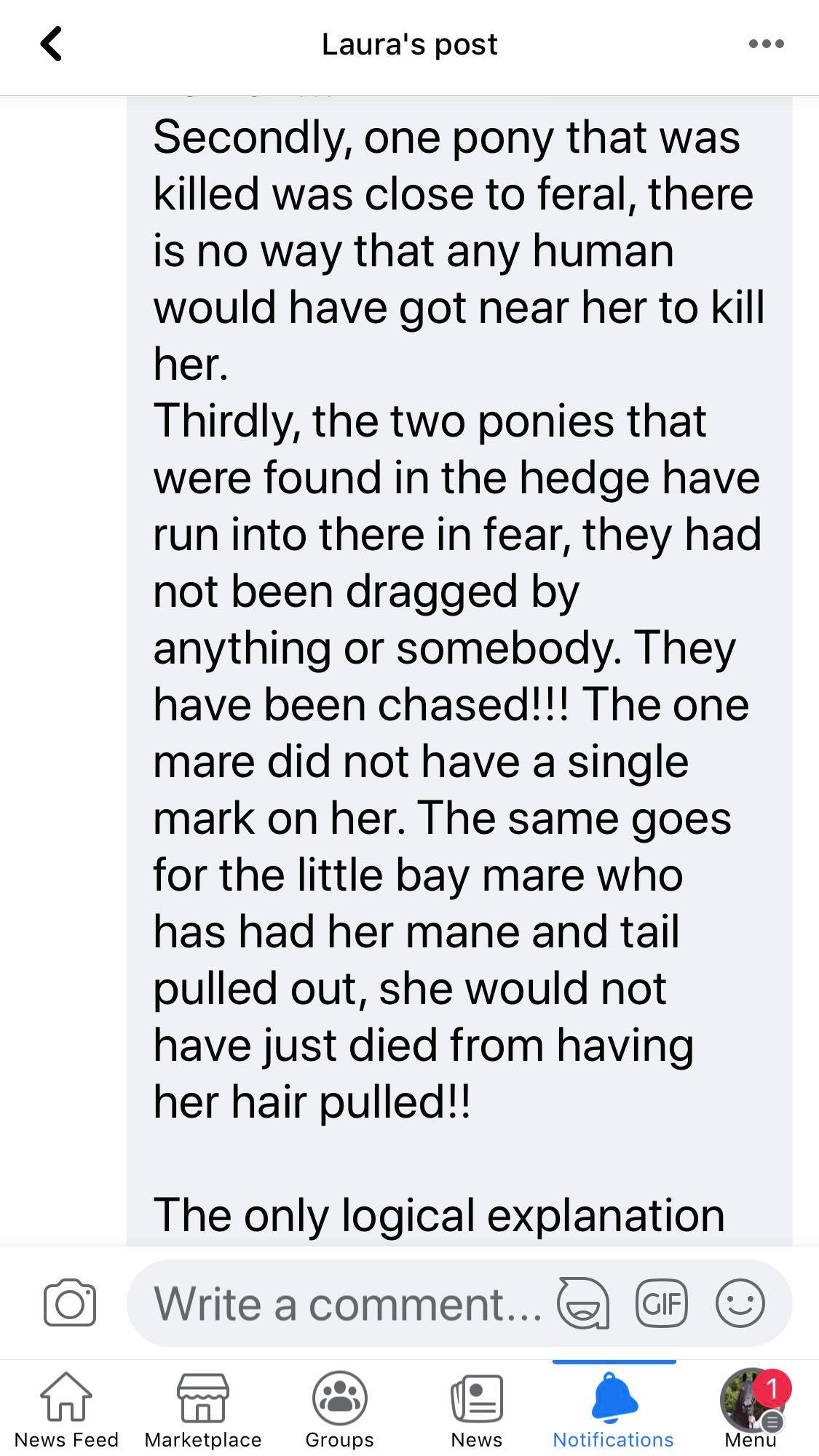
Two of the five were found head first deep in the hedge. One with lacerations to her back legs. Another mare has had her mane & tail ripped out and left scattered around her. The fourth had her stomach ripped open & the fifth has a small laceration on her stifle & bleeding from her mouth.
I’m heartbroken beyond words and can’t believe what’s happened.
I’ve asked a number of people to come and help me figure out what has happened (including my vet) and it appears a dog or some sort of animal has done this. If anyone else has experienced this in the area recently please let me know and maybe we can help each other figure out what it is that’s doing this.
Police & RSPCA have been informed.
This isn’t a post I thought I would ever need to share and don’t ever want to wake up to the scenes I found yesterday morning again.
Please let me know if you have any info.

The photos included -easily found online- were these.

GRAPHIC IMAGES


I sent the following message:

"Hello. My name is Terry Hooper-Scharf and I am a naturalist specialising in canid and felids (exotics) and from 1977 to 2013 (and still occasionally) I am a wildlife consultant to UK police forces on incidents allegedly relating to "big cats". I also worked with Swansea University when its Exotic Cat Group was active. I was forwarded a post about some of your Shetland ponies being killed. I wondered whether you could tell me what the vet involved thought re the cause of death and whether there were any other photographs of the dead ponies showing wounds"

I did point out in a comment that I was a little dubious about a "big cat" being responsible. The reason for this is simple; the hair from the main and tail pulled seemed to be more consistent with a canid attack. The cuts on the pony's leg were at odd angles that were not consistent with a large cats claws and the stomache ripped open has been noted in past known dog attacks. A large cat -leopard or puma would go forthe more isolated pony and the evidence for this having happened in the past in the UK is overwhelming and we have all of that evidence recorded and later added to by professionals at universities not associated with myself or the EAR.

I asked again whether any of the animal had been consumed and what the vet thought -it seems initially he had suggested an animal like a dog which is more consistent. Unfortunately everyone suddenly started chipping in about seeing or knowing "big cats" were around and a "big cat" group got involved. From that point things went downhill.

It is a simple and straightforward question to assess facts; what did the vet think -could I be put in touch with him? Howver, despite asking four times I have received no direct reply.

All above board, sensible and clear but I did not mention the dog idea outright as I needed the evidence or the opinion of the vet involved.

Today I was to find out the "response of the owners to his claims" -I had made no claims and as the owners refused to respond I could only conclude, to myself at the time, that this was a dog attack but not rule out a person also being involved. Here is that 'response':


I point out again that this was not sent to me by the owner and may have been in response to others who suggested dubious lampers and their dogs...

The dog and lampers seem a good theory but I need to keep pointing out the owners appear to have gone with the "Big Cat" group and theory rather than converse with myself so that facts can be double checked and the persistent refusal to discuss what the vet thought other than dog or other animal does not help.

I was a sceptic on large cats in the wild when I started but after four decades of seeing the evidence from dentition marks in bones, DNA, scat, many kills etc., I was very outspoken on the reality of large and small introduced cats in the UK -which police forces and even zoologists agreed with. It is why DEFRA became very opposed to my involvement in looking at any livestock deaths. And there is only one member of the big cat family in the UK so use of the term "Big cats" in all cases shows the competency of "Big Cat Groups".

To call me a "Big Cat sceptic" is like saying Dr Christian Barnard was against heart surgery.

Since my reputation is being impuned I take this opportunity to respond

Based on what I have read and seen this is not recorded as a cat attack.


Thursday, 9 September 2021

British "Big Cats" - My Background of 40+ Years


A little background seems to be necessary.

I started looking at reports of "big cats" in the UK in 1977. In was a young naturalist and I thought I would earn some good points reputation-wise when I prove it all a hoax. By 1978 I had spoken to naturalists, zoologists and many otherpeople who were credible and 95% of all sightings were at a distance of 10 feet (3m) to 200 yards under good lighting conditions. 

I saw the tracks and I realised that the obbservers were not all loopy or seeing things. In the decades since the evidence has grown and that includes DNA, scat analysis and much more. In 1977/1978 at the suggestion of a zoologist I took on the role of acting as an exotic animals advisor to UK police forces from Scotland to Northern Ireland, England and Wales.

I have contributed to technical papers:

1. A Method For Grading Sightings Of Non-Native Cats: Application to South and West Wales, UK: Professor Alayne Street-Perrott, Alaric B. Smith Exotic Cat Group University of Wales Swansea and Terry Hooper-Scharf Exotic Animals Register.

Proceedings of the 2nd Eastern Cougar Conference, Morgantown, West Virginia, 2004  


2. Exotic Cats In Britain: An Historical Perspective, Professor Alayne Street-Perrott, Alaric B. Smith Exotic Cat Group University of Wales Swansea and Terry Hooper-Scharf Exotic Animals Register, Proceedings of the 2nd Eastern Cougar Conference, Morgantown, West Virginia, 2004  


3. (Contributor) Survey effort and Sighting Probabilities for Non-Native Cats in Carmarthenshire, Professor Alayne Street-Perrott, Alaric B. Smith Exotic Cat Group University of Wales Swansea, Swansea Geographer 2004  vol. 39


4. The Biography of Perceived Encounters with Pumas and Other Exotic Cats in South and West Wales, UK; Alayne Street-Perrott, Alaric B. Smith Exotic Cat Group University of Wales Swansea and Terry Hooper-Scharf Exotic Animals Register. 2004


5. Felids: Wildcats, Ferals and Hybrids, Terry Hooper-Scharf. Vale Wildlife Group, 2000


6. UK National Wolverine Population and Evidence, Terry Hooper-Scharf, Vale Wildlife Group, November 2000


7. The Red Paper: Foxes, Fox-Domestic Dog, Hybrids, Arctic Foxes, Wolves, Jackals and Coyotes: An Extensive Study of Vulpes vulpes in the United Kingdom and Releases/Escapes of Non-Native Canids; Terry Hooper-Scharf.  Black Tower Books, 2011


8. The “Girt Dog” of Ennerdale: Hyena, Thylacine or Escaped Exotic Cat: A Naturalist’s Assessment of the Evidence. Terry Hooper-Scharf. Black Tower Books, 2018


Various other unlisted papers and articles 2000-2021.  I have cooperate with the National Farmers Union, Newquay Zoo, Swansea and other universities. farming colleges, veterinary schools as well as many others.

This work -including that to advise police forces- was all for free. Never one penny was paid out by anyone but myself. I attempted to avoid publicity as much as possible but even so guested on national, regional and local radio as well as in the newspapers (which called me in 1996: "Britain's Big Cat Detective" despite my protests).I have also contributed to publications on European wildcats and advised German police in "big cat" sightings as well as on wolves.

In over 4 decades I have studied kills put down to big cats as well as habits and habitats across the UK. Most of my contemporaries are now gone which makes me the most experienced naturalists dealing with the subject in the UK. A few newer people have appeared and most of them base their knowledge on the old EAR Bulletins and often misquote or deliberately get facts wrong.

Two things to note:

1) in over 40 years not one witness/observer has ever been named unless they have given out their name. Confidentiality of witnesses and maintaining that  is of great importance.

2) unlike some newer "Big Cat" people who really do not know the cats involved and hide their connections with hunting groups or persons out to kill the first "British Big Cat", I maintain absolute secrecy on locations and cat movements. This is to protect the witness, the animal involved as well as other animals as "hunters" have in the past shot sheep and other farm/domestic animals as "big cat"

The UK National CarnivoreAdvisory was set up to cover everything from foxes, badgers as well as introduced animals -canid or felid or even mustelid. It is the focal point for coordinating the British Fox Study (set up in 1976) and the EAR -for both there are public Face Book pages.

I can be personal message via the Face Book groupsor through email at blacktowercg@hotmail.com  in the strictest confidentiality.

The above is a very -VERY- brief piece of background information to reassure anyone who might have concerns that they need not worry.

Lynx CANNOT Be Reintroduced (ones already here can stay?)

  You see, if they ignore what they know (that there are lynx in the UK already and have been for decades -I even wrote a paper on the subje...